What is Dental Attrition?
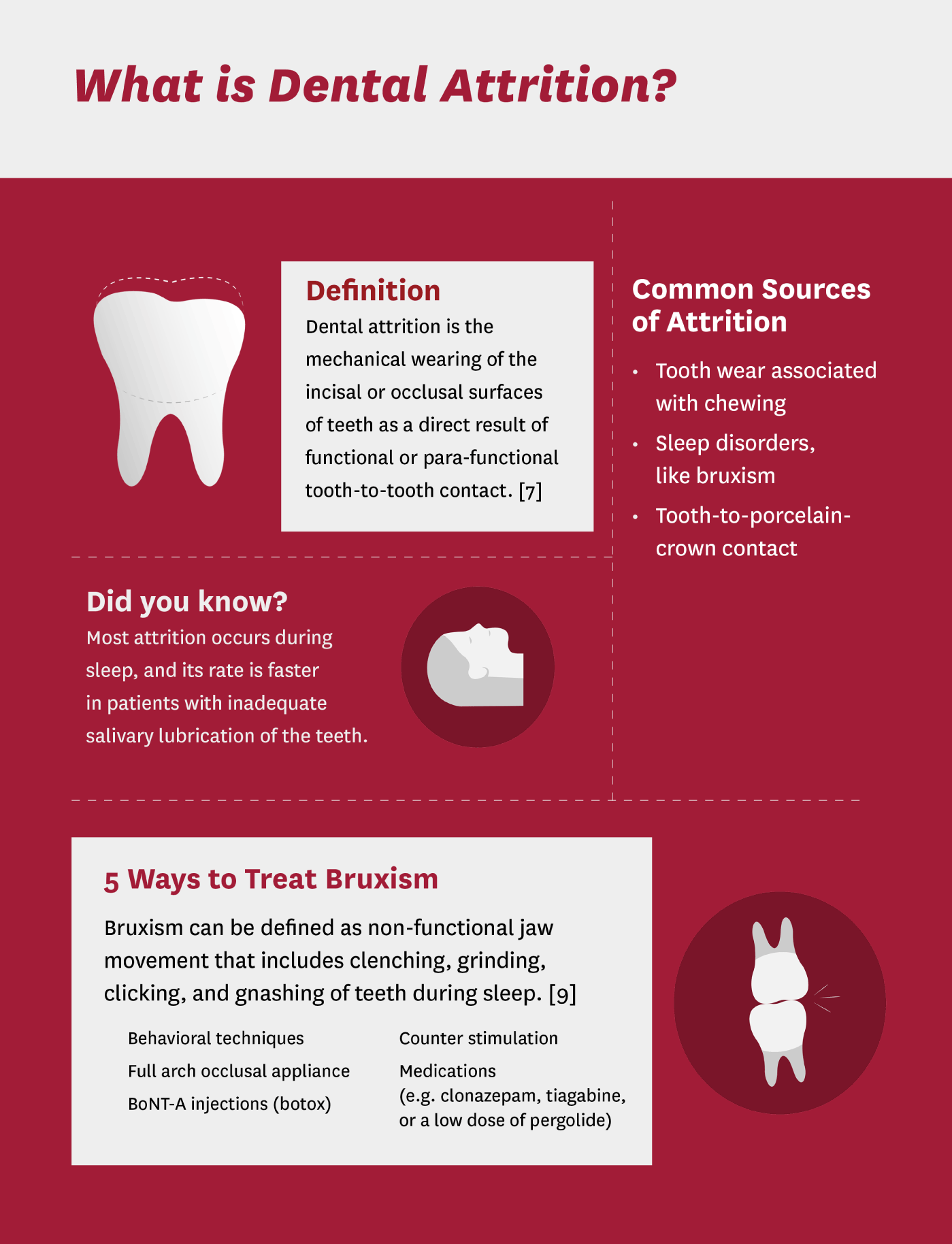
The definition of dental attrition is the mechanical wearing of the incisal or occlusal surfaces of teeth as a direct result of functional or parafunctional tooth-to-tooth contact.
The process is usually slow and rarely results in pulpal disease as secondary dentine is laid down to protect the pulp.
Tooth pain is rarely associated with attrition, and men typically show a greater degree of attrition than women.
Most attrition occurs during sleep, and its rate is faster in patients with inadequate salivary lubrication of the teeth.
Related Reading: How to Perform an Occlusal Analysis
Like what you’re learning? Take it a step further and test your clinical diagnosis skills with USC’s Virtual Patient Simulation. Review real-life patient histories, symptoms, and imaging, conduct a medical interview and clinical exam, make a diagnosis, and create a treatment plan for virtual patients experiencing Orofacial Pain conditions.

Are there different types of attrition of teeth?
Sleep Bruxism & Dental Attrition
There have been several articles on this topic. Baba K, Haketa T, Ohyama T, and I sought to answer the question, “does tooth wear status predict ongoing sleep bruxism in 30- year-old Japanese subjects?“
In our study comparing tooth wear and bruxism levels, we observed 16 subjects (8 bruxers & 8 age- and gender-controls) with a mean age of 30 years. We used Murphy’s method to form dental casts and measured bruxism level with EMG recordings for five nights.
We found Murphy’s scores and duration of bruxism levels were not correlated. In conclusion, tooth wear status is not predictive of ongoing bruxism level in 30-year-old Japanese subjects.
Why do some bruxers have tooth wear and some do not?
Lubrication is critical to the rate of wear. Johansson A, Kiliaridis S, Haraldson T, Omar R, Carlsson GE in their study, “Covariation of some factors associated with occlusal tooth wear in a selected high-wear sample,” investigated co-factors associated with occlusal tooth wear by studying 59 subjects with a mean age of 35 years, ranging from 16 to 70-year-olds. All subjects had a full or nearly full complement of natural teeth, and all had the presence of definite clinical signs of occlusal wear.
Results
- Men > women on wear of the teeth
- Greater age = greater wear
- Greater bite force = greater wear
- Decreased occlusal tactile sensitivity = greater wear
- Increased endurance time = greater wear
- Low buffer capacity and low rate of secretion = greater wear
In conclusion, the greater the force and inadequate lubrication produces more attrition!
Age Appropriate Attrition
| 0-20 | 25% | 5% | 0.5 |
| 20-40 | 50% | 10% | 1mm |
| 40-60 | 75% | 20% | 2mm |
| 60-80 | 100% | 30% | 3mm |
How is the severity of attrition scored?
- #0 = no wear at all
- #1 = small enamel wear (physiologic)
- #2 = large enamel wear (accelerated but no dentin exposed)
- #3 = large enamel & dentin exposed (<1/3 of crown).
- #4 = > 1/3 of crown lost
Dentist’s should also describe the region: Maxillary; Mandibular; Anterior; Posterior, or Generalized.
Is Bruxism strong enough to damage other tissue beyond the teeth?
Yes, we think Bruxism can stretch the TMJ tissues causing disk displacement.
Correlating TMJ Signs & Symptoms with Bruxism Level
In our article, Association between masseter muscle activity levels recorded during sleep and signs and symptoms of temporomandibular disorders in healthy young adults, we studied 103 healthy adult subjects (age 22-32 yrs). Each subject filled out questionnaires and were examined. Each subject had six consecutive nightly masseter EMGs.
'스토리 > 건강-스포츠' 카테고리의 다른 글
| 치아의 부식과 마모, 굴곡파절, (0) | 2025.12.27 |
|---|---|
| 정년 없는 의사, 은퇴 언제 하실 건가요? (1) | 2025.10.25 |
| 靑蒿护肤* Artemisia annua* 개똥쑥 (4) | 2025.10.11 |
| 임플란트 최저 55만 원 최대 250만 원 ‘4.5배’ (0) | 2025.09.25 |
| 재인청 (才人廳)* 전통 문화유산의 요람 (1) | 2025.09.24 |